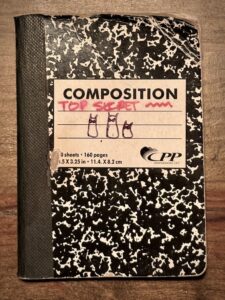
I recently cleared out an old purse. I found things I expected to – faded receipts, crumpled post-it notes with reminders, a wayward piece of wrapped candy trapped at the bottom, and a large paper clip that hitched a ride and never left. I had one unexpected, pleasant find – an old mini composition notebook that I had carried around to write down ideas on the go. I was years-late in the game of getting a smart phone, so my ‘notes app’ was this little 3×4 in. notebook that fit perfectly in an interior pocket. As I flipped through the pages, memories of the days when the notes were entered flooded in. Even after I had acquired a smart phone, I still kept the notebook in my purse, but rarely came back to it once I had started using the built-in notes app on my phone.
For generations, people of all ages and backgrounds have used compostion notebooks for class notes, to-do lists, meeting notes, and just about anything else that needs to be written down. They are inexpensive, sturdy and stackable. Additionally, they are flexible and durable. With sewn-in pages, notes will not fall out or be easily torn out as they would in notebooks with perforated or spiral bound pages. At approximately 7×9 in., the composition notebook is the perfect size – small enough to fit in various backpacks, purses or totes; and large enough to write comfortably in.
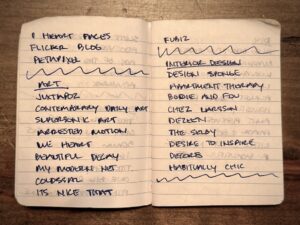
Most of the notes in my mini notebook relate to art project ideas, hex color codes for web design, artists to research, art blogs, and even a few to-do’s and reminders that needed attention at the time they were written. While a portion of that information is now old, irrelevant or no longer exists, it did bring back fond memories of what inspired me at the time, as well as rekindled ideas I still want to work with. I have a full-sized composition notebook (also titled “TOP SECRET” by my inner 4th grader) where I still write down detailed ideas and notes – as well as other additional notebooks dedicated to separate specific projects.
Although I regularly use the notes app on my phone, I now try to quickly transfer notes regarding ideas and other things I don’t want to forget to my notebook as soon as I can. I find in the digital age, it’s much easier for things to get lost in electronic clutter – it doesn’t take up physical space on a desk, or manifest in stacks in a corner to provide a visual reminder of things that haven’t yet gotten done. For me, ideas stay at the forefront longer when written by hand. With composition notebooks, one can still have physical notes on hand, but in a neater, more durable and compact format.
Modern notebooks with marbling began popping up in France and Germany in the middle of the 19th century before making their way to America in the late 19th and early 20th centuries. The marbling pattern created in Germany and seen both then and today as the inspiration for many composition book cover designs was known as the agate pattern. When that cover design caught on, it became easy for people looking for composition notebooks to spot one on a shelf. In a way, marbling became a way to “brand” this type of blank paper.